 ?>
?>
If you work in packaging, logistics, agriculture, printing, or industrial manufacturing, you may have come across corrugated plastic sheet as an alternative to cardboard, wood, or solid plastic boards.
But what exactly is it, and how do you know whether it is the right material for your application?
A corrugated plastic sheet is a lightweight plastic board made primarily from polypropylene. It consists of two flat outer layers connected by internal vertical ribs, creating a hollow structure. This design gives the sheet a useful combination of low weight, strength, moisture resistance, and durability.
Because of these properties, corrugated plastic sheets are widely used for reusable packaging, industrial containers, agricultural boxes, advertising signs, protective boards, and many other applications.
What Is Corrugated Plastic Sheet Made Of?
Most corrugated plastic sheet products are made from polypropylene, commonly referred to as PP. For applications that require higher strength, durability, or consistent performance, virgin PP material can be used.
Depending on the application, performance requirements, and customer’s budget, the material formulation can also be adjusted. Different additives or material combinations can help optimize properties such as UV resistance, antistatic performance, conductivity, or flame resistance.
At Junhui Plastics, we have nearly 30 years of experience in PP hollow sheet manufacturing. Rather than recommending the same material for every customer, we evaluate the actual application and help match the material formulation to the working environment.
| Feature | Corrugated Plastic Sheet Information |
|---|---|
| Material | Polypropylene (PP) |
| Structure | Two outer layers connected by internal ribs, forming hollow air channels |
| Thickness | Approximately 2–20 mm, depending on the application |
| Maximum Width | Up to 3 meters |
| GSM / Weight | Customized according to thickness, structure, and application requirements |
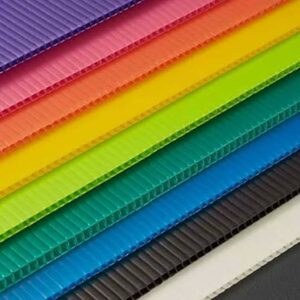
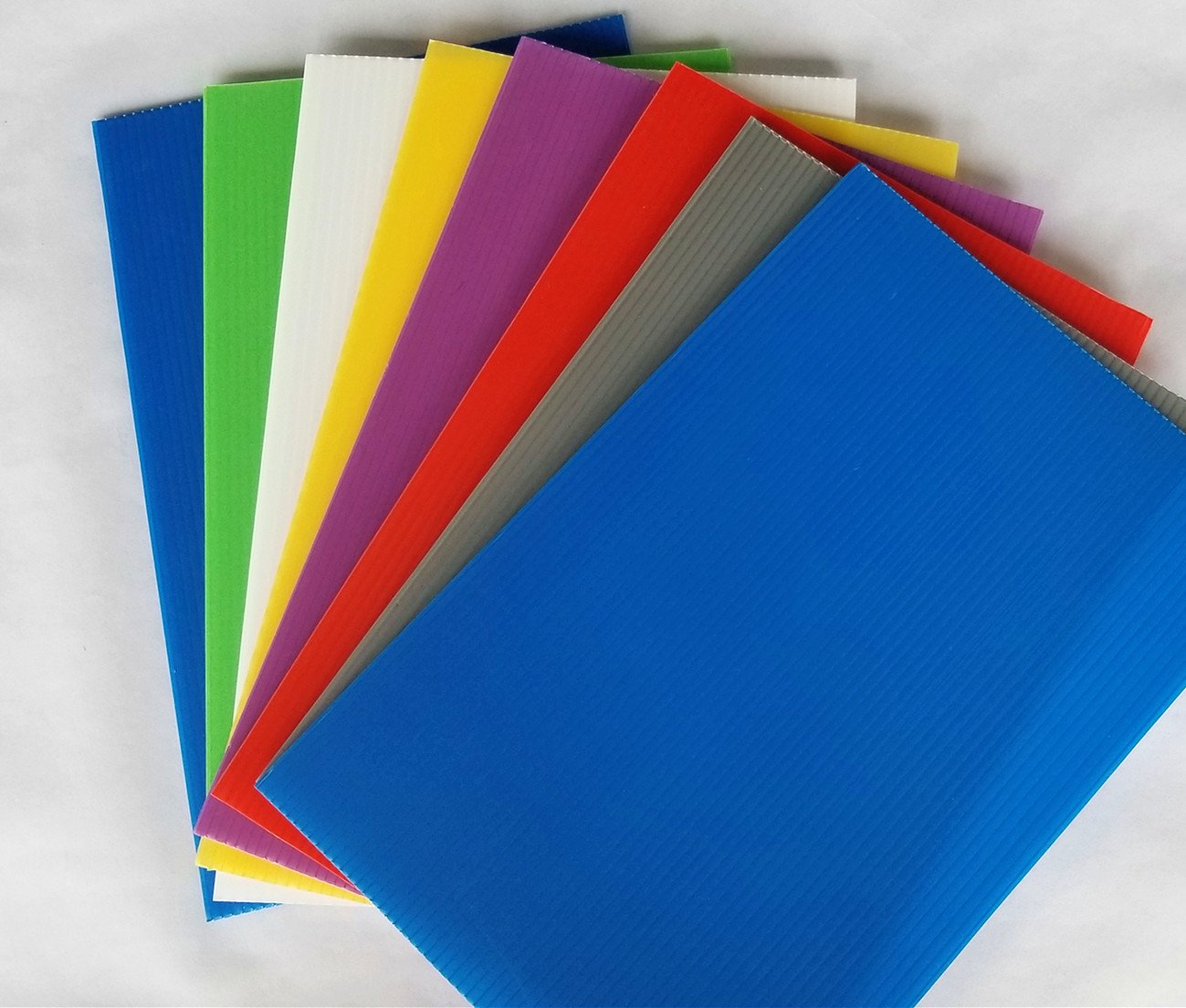
| Available Colors | Blue, green, red, white, gray, and other custom colors |
| Surface | Smooth, suitable for printing and further fabrication |
| Key Properties | Lightweight, waterproof, moisture-resistant, impact-resistant, corrosion-resistant, reusable, and recyclable |
| Optional Performance | UV-resistant, antistatic, conductive, flame-retardant, and other customized properties |
| Applications | Packaging, logistics, agriculture, automotive, electronics, construction, signage, and industrial protection |
| Customization | Thickness, size, GSM, color, structure, and functional properties |
| Typical Products | Reusable boxes, dividers, layer pads, protective sheets, advertising boards, and agricultural packaging |
How Is Corrugated Plastic Sheet Structured?
The structure of a corrugated plastic sheet is similar to a series of small I-beams running through the inside of the board.
It typically includes three main parts:
Face sheets: The upper and lower surfaces create a smooth outer layer that provides a good base for printing, moisture resistance, and surface protection.
Internal ribs or flutes: Vertical ribs connect the two outer surfaces and provide structural support.
Air channels: The hollow spaces between the ribs reduce the overall weight of the sheet while contributing to insulation and cushioning performance.
The spacing and structure of the internal ribs can be adjusted according to the required thickness and weight. In addition to standard hollow structures, special designs such as X-shaped or S-shaped internal structures can also be developed for specific applications.
How Is Corrugated Plastic Sheet Made?
The production process begins with raw material preparation. PP resin and selected additives are mixed according to the required product specifications.
The material is then melted and processed through an extrusion system. The molten PP passes through a specially designed die, which forms the sheet and creates its internal hollow structure.
After extrusion, the sheet goes through a forming and cooling process to stabilize its shape and dimensions. It is then cut according to the required size and inspected before packing.
A typical production process includes:
Raw material preparation → Extrusion → Sheet forming → Cooling → Cutting → Quality inspection → Packing
The production equipment and processing parameters can affect the final thickness, weight, width, surface quality, and structural performance of the corrugated plastic sheet.
Key Benefits of Corrugated Plastic Sheet
One of the main reasons this material is used across different industries is its combination of practical properties.
A corrugated plastic sheet can offer:
- Lightweight construction
- Water and moisture resistance
- Good impact resistance
- Corrosion resistance
- Reusability
- Recyclability
- Easy cleaning
- Custom colors and sizes
- Good strength-to-weight performance
- Optional functional properties such as UV resistance, antistatic protection, conductivity, or flame resistance
Unlike materials that are designed for one-time use, PP corrugated sheets can be used repeatedly when the application and handling conditions are suitable.
Common Applications of Corrugated Plastic Sheet
Because the material can be customized in thickness, weight, color, size, and performance, corrugated plastic sheet is used in a wide range of industries.
Common applications include:
Packaging and logistics: Reusable boxes, turnover containers, bottle layer pads, pallet protection, and internal packaging.
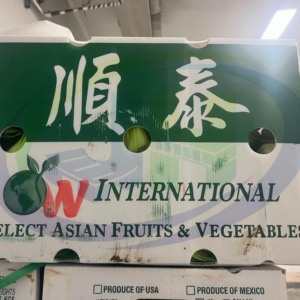
Agriculture: Vegetable and fruit packaging, agricultural containers, and reusable produce boxes.
Industrial manufacturing: Protective packaging for components, instruments, hardware, household appliances, and precision parts.
Automotive applications: Custom packaging, protective separators, and specialized interior components.
Advertising and printing: Indoor and outdoor signs, display boards, exhibition materials, and printed promotional panels.
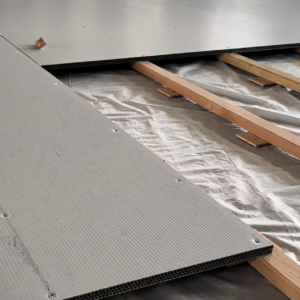
Construction and protection: Temporary protective sheets and other applications where lightweight and moisture-resistant materials are required.
For special applications, the sheet can also be modified to provide additional performance. For example, an antistatic corrugated plastic sheet may be used for electronic components, while UV-resistant materials can be more suitable for long-term outdoor exposure.
| Thickness | Example Weight | Application Consideration |
|---|---|---|
| 3.5 mm | 1,000–1,200 g | Higher weight and stiffness requirements |
| 3.8 mm | Approx. 730 g | Lightweight packaging and general applications |
| 4 mm | Approx. 750–800 g | General packaging and industrial use |
| 5 mm | Approx. 900–1,000 g | Reusable boxes and heavier-duty applications |
Thickness and GSM should not be considered separately. Two sheets with the same thickness can have different weights and performance depending on their material formulation and internal structure. This is why we normally recommend selecting the sheet according to the actual application rather than simply choosing the thickest option.
Corrugated Plastic Sheet VS Cardboard
Cardboard remains a popular packaging material, but it has limitations in environments involving moisture, repeated handling, or long-term use.
A corrugated plastic sheet offers several advantages over traditional cardboard.
It is waterproof and moisture-resistant, making it suitable for humid environments or applications where cleaning is required. It can also be reused multiple times, while cardboard may gradually lose strength after repeated handling or exposure to moisture.
Plastic corrugated sheets can also be customized in different colors and modified with functional additives. Depending on the application, this may include UV resistance, antistatic properties, or flame-retardant performance.
However, cardboard may still be a practical option for low-cost, single-use packaging. The best material depends on how often the packaging will be used and the environment it needs to withstand.
How to Choose the Right Corrugated Plastic Sheet
Choosing the right corrugated plastic sheet is not simply about selecting a thickness.
Several factors should be considered before production:
- What will the sheet be used for?
- Will it be used indoors or outdoors?
- Does it need to work in cold storage or humid conditions?
- What size and thickness are required?
- What weight or load does it need to support?
- Is printing required?
- Does the application require UV resistance, antistatic protection, or flame resistance?
Thickness can typically be customized from approximately 2 mm to 20 mm, depending on the required application. Weight and structural design also need to be considered together. A thicker sheet does not automatically mean it is the best solution. The internal structure, material formulation, and GSM can all affect the final performance.
Working With an Experienced Corrugated Plastic Sheet Manufacturer
Choosing the right manufacturer can make a significant difference when your application requires customized performance.
Junhui Plastic has nearly 30 years of manufacturing experience in PP hollow sheets. With 12 production lines, a maximum sheet width of up to 3 meters, and the ability to produce a wide range of customized specifications, we can respond to different packaging and industrial requirements.
Our technical team and laboratory equipment support quality control from raw material inspection through finished product testing. Based on experience gained from serving customers in markets including Europe, Japan, Australia, and Southeast Asia, we can also recommend suitable solutions based on real application conditions.
Whether you need a standard corrugated plastic sheet or a customized solution for packaging, logistics, agriculture, printing, or industrial applications, understanding the actual working environment is the first step toward choosing the right material.
The right sheet should not simply be the thickest or lowest-priced option. It should be designed around how the product will actually be used.