 ?>
?>
Why Does Hollow Plastic Formwork Become Soft in High Temperature Environments?
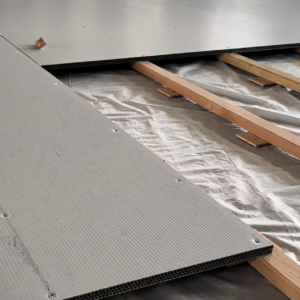
Recently, we received an inquiry from a European customer who had purchased plastic sheets from another supplier and used them in a construction project in Turkey.
The customer told us that when the outdoor temperature reached around 40-50℃, the plastic boards became soft and deformed, which seriously affected the construction process.
At first glance, many people may think this problem is caused by the hot weather itself. However, the real reason is usually related to the material quality and formulation of the plastic sheet.
For construction applications, especially outdoor projects, choosing the correct PP hollow plastic formwork material is extremely important.
The Main Reason: Insufficient Temperature Resistance of Raw Materials
The temperature resistance of hollow plastic formwork mainly depends on:
- Raw material quality
- Molecular structure stability
- Material formulation
- Manufacturing process
Some low-cost plastic sheets on the market are produced using a high percentage of recycled materials.
Although recycled PP materials can reduce production costs, after repeated recycling and long-term melting processing, the polymer molecular chains may become damaged and degraded.
This leads to:
- Lower mechanical strength
- Reduced impact resistance
- Poor heat stability
- Higher risk of deformation under high temperatures
When these boards are exposed to strong sunlight or hot outdoor environments, they may become soft, lose rigidity, or fail to maintain their original shape.
How We Solve High Temperature Application Problems
For customers working in hot climates, we recommend using our high temperature resistant hollow plastic formwork.
Compared with ordinary PP boards, our high-temperature resistant material uses a specially optimized formulation to improve thermal stability.
The advantages include:
Excellent Heat Resistance
Our customized material can withstand temperatures up to 130℃, making it suitable for:
- Hot climate construction sites
- Outdoor concrete projects
- Desert regions
- High-temperature working environments
Better Shape Stability
Even under continuous exposure to heat and sunlight, the board maintains:
- Flatness
- Structural strength
- Reusability
- Construction performance
This helps customers reduce replacement costs and improve project efficiency.
What About Low Temperature Applications?
Temperature resistance is not only about high temperatures.
Some customers also need plastic formwork for cold regions where materials may become brittle under low temperatures.
For these applications, the material formula needs different adjustments.
Low temperature resistant PP hollow plastic formwork usually requires:
- Rubber-based elastomer modification
- Special impact-resistant additives
- Improved molecular flexibility
These improvements help the board maintain toughness and prevent:
- Cracking
- Breaking
- Impact damage
in cold environments.
Why Sending a Random Sample Is Not Enough
In the plastic formwork industry, many customers simply tell suppliers:
“I need 15mm or 18mm thickness plastic formwork.”
Then suppliers usually send a standard sample directly.
However, thickness is only one factor.
The real application environment is much more important.
For example:
A board used in Turkey under 50℃ outdoor temperatures requires different material performance compared with:
- A construction project in Northern Europe
- A cold storage environment
- A high-impact construction site
Even if a standard sample performs well during testing, problems may appear after:
- Mass production
- Long-term outdoor exposure
- Repeated construction use
- Large-scale project application
Therefore, before recommending materials, professional suppliers need to understand:
- Where will the product be used?
- Indoor or outdoor application?
- Maximum and minimum temperature?
- Expected service life?
- Reuse frequency?
- Construction requirements?
Only after understanding these details can we provide the right solution.
Customized Material Solutions Based on Real Applications
At Junhui Plastic, we do not only manufacture hollow plastic boards.
We focus on providing application-based material solutions.
According to different customer requirements, we can customize:
- Material formulation
- Thickness
- Size
- Color
- Surface treatment
- Performance requirements
Whether your project requires:
- High temperature resistance
- Low temperature resistance
- Higher impact strength
- Longer service life
we can help develop a suitable PP hollow plastic formwork solution.
Choose Junhui Plastic for Reliable Hollow Plastic Formwork Solutions
Choosing the right hollow plastic formwork supplier is not only about purchasing a plastic sheet.
It is about choosing a material that can perform reliably in real working conditions.
With experience in customized PP hollow plastic products, Junhui Plastic helps global customers solve challenges caused by temperature, environment, and application requirements.
If you are looking for high temperature resistant or low temperature resistant hollow plastic formwork, contact Junhui Plastic for a customized solution.
FAQ
Q1: Can hollow plastic formwork be used in hot climates?
Yes. High-temperature resistant PP hollow plastic formwork can be customized for outdoor construction environments with extreme heat.
Q2: Why does plastic formwork become soft under sunlight?
Usually because the material has poor heat stability or contains too much recycled material with degraded molecular structure.
Q3: What temperature can PP hollow plastic formwork withstand?
Our high-temperature resistant material can withstand temperatures up to 130℃ depending on formulation and application requirements.
Q4: Can plastic formwork be customized for cold weather?
Yes. Low-temperature resistant formulations with elastomers and special additives can improve flexibility and impact resistance in cold environments.