 ?>
If you work in agriculture, automotive manufacturing, apparel, or logistics, you may have seen lightweight plastic boxes replacing traditional cardboard packaging. These are known as corrugated plastic boxes, and they are increasingly used when businesses need packaging that can handle moisture, repeated use, and frequent transportation.
But what exactly are they, and how are they different from ordinary cardboard boxes?
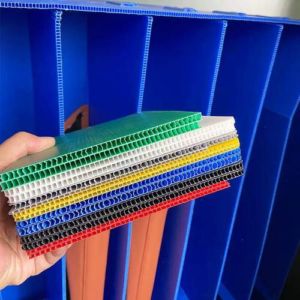
In simple terms, corrugated plastic boxes are reusable containers made from polypropylene (PP) hollow sheets. Instead of the paper layers found in cardboard, the sheet has two flat plastic surfaces connected by vertical ribs. This hollow structure keeps the material lightweight while providing the rigidity needed for packaging and material handling.
What Are Corrugated Plastic Boxes Made Of?
Most corrugated plastic boxes are made from polypropylene. During production, PP material is melted and extruded through a die to create a hollow, twin-wall sheet.
The sheet can then be cut, creased, welded, folded, printed, or assembled into different box structures.
There is no single thickness that works for every application. Based on our production experience at Junhui, boxes for vegetables, fruits, and agricultural products commonly use sheets between 3 mm and 4 mm. Among them, 3.5 mm, 3.8 mm, and 4 mm are frequently selected.
Sheet weight is another important factor. We commonly work within a range of 500–1,000 gsm, while 700–800 gsm is used for many standard applications.
The required specification depends on the load. A box carrying heavier products generally needs a higher sheet weight and stronger construction rather than simply increasing thickness.
Why Do Businesses Use Corrugated Plastic Boxes?
One of the biggest advantages is moisture resistance.
Traditional cardboard absorbs water and loses strength when exposed to moisture. PP does not absorb water in the same way, making it practical for agricultural packaging, warehouses, and other environments where boxes may come into contact with water.
The boxes are also washable. They can be cleaned with water and wiped dry before returning to use, which is useful in reusable packaging systems.
Another important difference is service life.
We have a real example from a customer in Southeast Asia’s apparel industry. The customer purchased a batch of boxes from us in August 2018 for moving semi-finished garments through its production process.
Those same boxes are still in use today.
This is not an occasional storage application. According to the customer’s usage, the boxes circulate for at least 8–10 hours per day. Of course, this does not mean every plastic box will last that long. Service life varies with load, handling, material specification, box construction, and working conditions. But it shows what reusable PP packaging can achieve in the right application.
Corrugated Plastic Boxes vs. Cardboard Boxes
Cardboard remains a practical choice for many one-way shipments. However, problems can arise when moisture is involved.
We encountered this with an agricultural packaging customer in Los Angeles. Local growers had traditionally used cardboard boxes for vegetables and agricultural products. Because the packaging needed water resistance, wax had to be applied to the outside of the cardboard.
That added cost, but the boxes were still relatively easy to damage and difficult to recycle after use.
As plastic corrugated packaging became more widely available, the customer moved away from these wax-coated cardboard boxes and adopted plastic alternatives.
This example also highlights why buyers should not compare packaging based only on the initial price per box. For reusable applications, it makes more sense to consider cost per use.
A cardboard box may cost less initially, while a reusable plastic box may complete many more circulation cycles.
Where Are Corrugated Plastic Boxes Used?
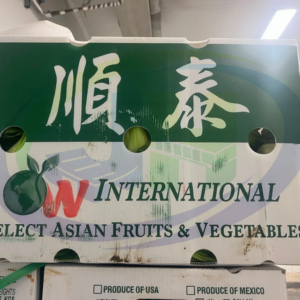
Agriculture is one common application. Boxes can carry vegetables, fruits, and other produce while providing better resistance to wet environments. Logos and other graphics can also be printed directly on the boxes.
For our Los Angeles customer, for example, the boxes are printed with the customer’s logo. This turns transportation packaging into part of the company’s brand presentation rather than leaving it as a plain container.
The automotive industry has different requirements.
For an Australian customer, we manufacture packaging used for automotive rearview mirrors and other components. Corrugated plastic sheets can be combined with EVA foam and internal dividers to create separate spaces for individual parts. This helps organize components and reduces direct contact during handling and transportation.
We also see the material used in apparel factories, warehouses, production lines, parts storage, and other closed-loop logistics systems.
Can Corrugated Plastic Boxes Be Customized?
Yes, and customization goes far beyond changing the box dimensions.
Depending on the product and application, manufacturing can include:
- Cutting and die cutting
- Creasing and folding
- Welding and heat sealing
- Printing
- Riveting
- Box assembly
- Custom sizes
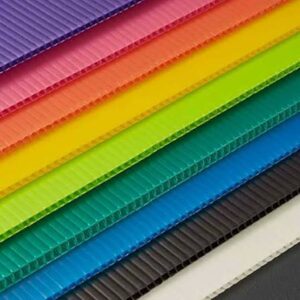
- Custom colors
- Internal dividers and protective inserts
At Junhui, we have the equipment to complete these processing steps in-house. This allows the box structure to be designed around the product rather than forcing the product into a standard box.
For example, agricultural packaging may focus on moisture resistance, easy cleaning, and branding, while automotive packaging may require dividers, EVA protection, and precise internal dimensions.
How Do You Choose the Right Box?
Start with the product rather than the box.
Provide your supplier with the product dimensions, weight, quantity per box, stacking requirements, transportation method, and expected reuse frequency. If possible, also explain where the box will be used.
From there, the manufacturer can determine an appropriate sheet thickness, gsm, box structure, and reinforcement method.
Choosing a thicker sheet does not automatically mean choosing a better box. The goal is to match the material and structure to the actual load and working environment.
Frequently Asked Questions
Are corrugated plastic boxes waterproof?
The PP sheet itself does not absorb water like cardboard and can be washed. However, whether a finished box is completely waterproof depends on its structure, seams, openings, and design.
How long do corrugated plastic boxes last?
There is no fixed lifespan. It depends on material specifications, load, handling frequency, and working conditions. In one of our apparel applications, boxes manufactured in August 2018 remain in daily circulation today.
Can I print my logo on the boxes?
Yes. Logos, company information, handling instructions, and other graphics can be printed on the surface.
Can corrugated plastic boxes include dividers?
Yes. Internal PP dividers can be customized, and protective materials such as EVA can also be added for products that need additional protection.
Final Thoughts
Corrugated plastic boxes are more than a plastic version of a cardboard box. Their value becomes clearer when packaging needs to resist moisture, move repeatedly through a supply chain, protect parts, or be cleaned and returned to service.
For some businesses, cardboard remains the simplest solution. For others, especially those using returnable packaging, a properly designed PP box can provide a much longer working life.
The key is to choose the thickness, sheet weight, structure, and internal protection according to the actual product—not simply select the heaviest box available.